
Open Request for Proposal (RFP)
Published 7/31/2024
Project Title: Development of "Would I Lie?!" Game Phase 1
Introduction
Gig Game Corp. invites proposals for the development of a social trivia game titled "Would I Lie?!". This game combines knowledge, strategy, and deception in a team-based format. The game will be built using the Gig Game JS Framework and will be host-controlled, designed for mobile platforms with HUD display integration. It is intended to host this game on the gig.game platform.
Project Goals
- Develop a fully functional "Would I Lie?!" game.
- Ensure seamless integration with mobile devices and HUD display.
- Implement mechanics for team formation, question and answer rounds, and deception phases.
- Create an intuitive user interface with animated graphics in an old game show style.
- Ensure a smooth, engaging, and balanced gameplay experience.
Project Scope
1. Game Overview
- Title: Would I Lie?!
- Genre: Social Trivia Game
- Platform: HTML, Javascript, HTML Canvas (optional) with Gig Games JS library.
- Description: A trivia game that combines knowledge, strategy, and deception in a team-based format.
Note: This game is designed to be a web-based application that will run on the Gig Game online platform using the $GG library described in this documentation repository. The $GG library is our proprietary, in-house developed library built specifically for our service at https://www.giggamestudios.com. If any functionality is missing or needs to be supported for this project, we will work to provide it to the developer.
Please review related topics for working with the $GG Library:
- Explore How to Make a Gig Game
- Review ALL $GG API Endpoints
- Learn about Client/Server Event Communications
- Learn about the Asset Manager
- Learn about the HUD Manager
- Learn about the Audio Manager
- Learn about the Input Manager
- Learn about the Visual FX Manager
- Learn about using Globalization
- Two-Way Web View Binding
2. Gameplay Mechanics
Team Formation
- Teams are supported and are formed through the mobile app via QR code.
Question and Answer Rounds
- The game consists of 20 rounds by default (adjustable by the host) or manually controlled.
- Each round presents a trivia question on mobile devices and the HUD.
Answer Submission and Deception Phase
- Teams have a default of 60 seconds (controlled by the host) to discuss and submit an answer. This is displayed on the HUD. Host can end round early.
- This phase allows teams to submit a deceptive answer to mislead others or opt not to submit an answer if they choose not to participate in deception.
3. Host Control and Game Flow
- The game host controls the progression through each question and manually manages each step of the game.
Host Controls Include:
- Starting the game, choosing question categories, and initiating each round.
- Displaying questions on the HUD.
- Managing the timer duration for the discussion and submission phases.
- Filtering out any vulgar deceptions to maintain game appropriateness.
4. Answer Compilation and Selection
- Following the submission phase, all answers, including potential deceptions, are compiled and displayed.
- Players select what they believe is the correct answer from this list.
5. Scoring System
Correct Answer
- +500 points for choosing the correct answer.
Deception Points
- +100 points for each team that selects a deceptive answer.
Incorrect Answer Penalty
- -100 points for choosing a wrong answer.
'It's All Lies' Option
- In random rounds, the correct answer might be replaced with "It's All Lies".
- This wording should be randomly included alongside correct answers as well to throw players off.
- Correctly identifying "It's All Lies" awards a significant bonus (e.g., 1000 points).
Final Rounds Multiplier
- The last 5 rounds feature a double points multiplier.
6. Player Interaction
- Image and Chat Submissions
- Players can submit related images and chats via mobile. (Already supported by framework)
- These are displayed on the HUD and moderated. (Already supported by framework)
7. HUD and Mobile App Integration
Mobile App Functions
- For answer submissions, team communication, and viewing compiled answers.
HUD Display Functions
- Displaying questions, answers, scores, and player submissions.
- The HUD will be displayed on a TV.
8. Content and Regular Updates
Categories
- A central JSON file will include categories.
- Various topic questions separated in their own JSON files by category.
- Will be supplied by Gig Game Corp.
9. Technical Requirements
User Interface
- Creating intuitive graphical animated interfaces (old game show style) for both mobile and HUD.
Gig Game JS Framework
10. Testing and Quality Assurance
Gameplay Balance
- Testing to refine scoring balance and deception mechanics.
Appendix: Detailed Gameplay Flow
1. Game Initialization
- Game host shares HUD to screen.
- Intro displayed with QR Code with graphic and background music.
- Players scan a QR code to join the game and shown an intro graphic with a button to join the game.
- Players can create or join a team. They wait for host to start game.
2. Starting a Game
- The game host initiates the game via the host control panel.
- Host can set times for rounds, set the number of rounds, and can pick questions or have system pick one at random.
- Host can manually choose next question , let system pick on at random (with button), and/or designate "It's All Lies" questions for next question.
- First round starts with button click from host
3. Rounds repeat
A. Round graphic displays with round number and fades after 5 seconds
- Both on HUD and game controller to indicate start of new question.
B. Question and Deception Phase
- The game displays the question on both mobile devices and HUD.
- Teams discuss their answers privately within a set time (timer showing on screen).
- Teams can submit a deceptive answer or skip. First on the team to provide decides for the whole team. Host receives a list of deceptions and can reject any vulgar ones.
- Once answered, they wait for host to proceed to next phase.
C. Selection Phase
- Players individually select the answer they believe is correct.
- Selections are locked in after a set time.
- Once selected, they wait for host to proceed to next phase.
D. Scoring and Feedback Phase
- Scores are calculated based on the correctness of the answers and deception success.
- Scores and standings are displayed after each round in an animated graphic.
- The last 5 rounds have a scoring multiplier to intensify competition.
E. Host Actions During Feedback Phase
- Host can choose to proceed to the next round, end the game early, restart with existing teams, or restart the game with new teams.
- Host can manually choose next question , let system pick on at random (with button), and/or designate "It's All Lies" questions for next question.
6. End of Game
- Scores are tallied, and the winning team is announced.
- Detailed breakdown of points and performance is provided in an animated fashion.
7. Post-Game
- Host can choose to start a new game. Go back to step 2 with existing teams or without them.
Notes
- Game music has already been licensed. Only sound effects need to be provided. Music can be heard here to get vibe of game.
- A credit screen needs to be created to display those involved in creating the game.
Future Scope in Phase 2 for Planning Architecture
To enhance the game experience further, we envision a future scope where the trivia game is fully automated and hosted by a virtual game show host with audio on the console. This includes:
- Automated Game Flow: The game progresses automatically without the need for a manual host.
- Virtual Game Show Host: An AI-driven virtual host that presents questions, interacts with players, and provides commentary throughout the game.
- Audio Integration: The virtual host's audio will be integrated into the console, providing a more immersive experience.
- Advanced AI Mechanics: AI to handle dynamic question selection, real-time player interaction, and adaptive difficulty levels.
- Enhanced User Interface: Upgraded UI to support the automated features and virtual host interactions.
- Not as Part of this RFC: This is for planning purposes only and would be done under a seperate RFP.
This future scope aims to make "Would I Lie to You?" a more engaging and seamless experience for players.
Proposal Requirements
Interested parties should submit a proposal that includes the following:
- Executive Summary: Brief overview of the proposal.
- Technical Approach: Detailed explanation of the development process, including technologies and methodologies to be used.
- Experience and Qualifications: Relevant experience and qualifications of the development team.
- Project Plan: Timeline with key milestones and deliverables, including:
- Timeframes for each phase of development.
- Sprint schedules.
- Demoable milestones.
- Testing and QA phases.
- Cost Estimate: Detailed budget for the project.
- References: Contact information for previous clients who can speak to the quality of your work.
Evaluation Criteria
Proposals will be evaluated based on the following criteria:
- Understanding of project requirements.
- Technical competence and experience.
- Quality of the proposed solution.
- Project timeline and deliverables.
- Cost-effectiveness.
- References and past performance.
Submission Deadline
Proposals must be submitted by September 30, 2024 11:59PM. Please send your proposals to rfp@sparkinnovationscorp.com.
Contact Information
For any questions or further information, please contact:
- Jason M Bramble
- President
- jason.bramble@sparkinnovationscorp.com
- +1 4074887197
We look forward to receiving your proposal and working together to bring "Would I Lie?!" to life.
Addendum 08-08-2024
I've received several questions, and I’m providing this information to offer some clarification.
Game Parts and Flow
This game is designed for local, in-person play with groups, such as during a game night at home or at a restaurant. Teams are formed based on their physical proximity, like those sitting around the same table.
Game Management:
- Host Control: A designated host oversees the game and can:
- Manually control the game, including transitioning between rounds and selecting questions.
- Automation: Currently, automation is not available but will be introduced in Version 2 (outside scope of this RFP). This is only mentioned for planning purposes.
Displays:
- Mobile Devices: Players use their mobile devices to interact with the game. The game screens on these devices will guide them through each round.
- Host Console: I can provide a basic HTML template for the host’s interface. However, you are welcome to design a user-friendly interface of your own.
- HUD Display: The host will project game information onto a TV screen using a HUD (Heads-Up Display). This screen should mirror the information displayed on the mobile devices.
- The $GG library supports this with either HTML or HTML5 canvas. I will provide samples showing how this works, as I already have a few apps written. Essentially, it operates as another modal browser window controlled by the host console.
Below are the screens and workflow I envisioned from the client perspective. I can provide image assets if needed. Much of this can be replicated using basic CSS.
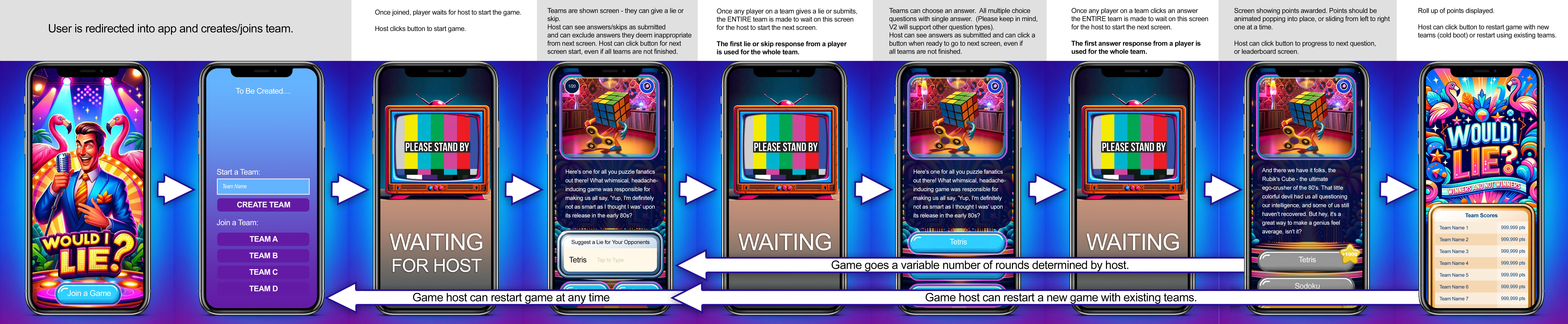
Project Structure Overview
Example Structure:
/project-root
├── /console
│   └── index.html
├── /controller
│   └── index.html
└── /engine
    └── engine.js
This project utilizes JavaScript, HTML, and optionally HTML5 Canvas, and can be developed locally on your workstation using our sandbox environment for testing. The project is organized into three main folders:
/console: This folder contains the
index.htmlfile for the host console. The host console is used for managing and controlling the game. More info here on communications/controller: This folder also contains an
index.htmlfile, which is for the player controllers. The controller handles interactions and submissions from the players./engine: This folder includes the
engine.jsfile (containing the Engine class), which houses the core game logic and functionalities. More info on engines here
You have flexibility to include other files or folders as needed within these directories, beyond the core requirements listed. The $GG library facilitates communication between these components by handling events. It enables devices to send and receive events, allowing interactions with the host, individual players, all players, or the game engine.
The $GG library ensures smooth integration and communication across the different parts of the game, enabling a cohesive and interactive experience.
Sample Trivia File JSON Data
Here is the general structure of the JSON data files for questions. Detailed samples, including images, will be provided at the start of development.
data/assets.json Sample Structure
Contains a list of topics the game will support.
[
    {
        "Topic": "Movies & Television",
        "Tag": "MoviesTelevision",
        "Categories": "Popular Movies,Popular TV Shows,Popular Actors,Film Directors,Movie & TV Awards",
        "Count": 108
    },
    {
        "Topic": "Music",
        "Tag": "Music",
        "Categories": "Musical Artists,Albums,Hit Singles,Music History,Music Awards",
        "Count": 108
    },
    {
        "Topic": "History",
        "Tag": "History",
        "Categories": "World History,U.S. History,Ancient Civilizations,Historic Battles,Significant Events",
        "Count": 108
    },
    {
        "Topic": "Science & Nature",
        "Tag": "ScienceNature",
        "Categories": "Biology,Chemistry,Physics,Space,Environmental Science",
        "Count": 108
    }
    //... other topics
]
data/music.json Sample Structure
Each category has its own JSON data file with qustions and images for game.
[
    {
        "QuestionType": 0,
        "QuestionText": "Which famous 'Gaga' had a meteoric rise to fame, starred in a blockbuster, and still has time to change hair colors more often than a traffic light?",
        "Category": "Musical Artists",
        "Difficulty": "Easy",
        "ImageUrl": "/data/Music/be51b262-4796-441e-950d-73d065de5bec.jpg",
        "Word": null,
        "Answers": [
            {
                "AnswerText": "Lady Gaga",
                "IsCorrect": true,
                "OrderIndex": 0
            },
            {
                "AnswerText": "Beyoncé",
                "IsCorrect": false,
                "OrderIndex": 10
            },
            {
                "AnswerText": "Madonna",
                "IsCorrect": false,
                "OrderIndex": 20
            },
            {
                "AnswerText": "Rihanna",
                "IsCorrect": false,
                "OrderIndex": 30
            },
            {
                "AnswerText": "Britney Spears",
                "IsCorrect": false,
                "OrderIndex": 40
            }
        ]
    },
    {
        "QuestionType": 0,
        "QuestionText": "Alright, pop pickers, what classic album cover features the iconic image of a naked baby swimming towards a dollar bill on a fishing line? Don't you wish your baby photos were this cool... or maybe not?",
        "Category": "Albums",
        "Difficulty": "Moderate",
        "ImageUrl": "/data/music/4014ea62-7bd4-4e3e-ad9e-93b2b75736cb.jpg",
        "Word": null,
        "Answers": [
            {
                "AnswerText": "Abbey Road by The Beatles",
                "IsCorrect": false,
                "OrderIndex": 10
            },
            {
                "AnswerText": "Dark Side of The Moon by Pink Floyd",
                "IsCorrect": false,
                "OrderIndex": 20
            },
            {
                "AnswerText": "Nevermind by Nirvana",
                "IsCorrect": true,
                "OrderIndex": 30
            },
            {
                "AnswerText": "The White Album by The Beatles",
                "IsCorrect": false,
                "OrderIndex": 40
            },
            {
                "AnswerText": "The Wall by Pink Floyd",
                "IsCorrect": false,
                "OrderIndex": 50
            }
        ]
    }
    //... other questions
]
Questions and Answers
Do we need to build the game to support multiple games running simultaneously?
- No, you don't need to. The Gig Game Framework handles this for you. Each game instance, identified by a unique game code, is managed separately by our communications server, which creates a new JS class instance for each game. Our service ensures that communication between consoles, controllers, and the engine is isolated by game code. You can assume your game engine will handle only one instance of the game.
Do we have access to any storage mechanisms (e.g., database)?
- No, you do not. The Gig Game Framework manages data storage. Your game engine should handle all necessary data locally. Implement two functions,
serializeanddeserialize, in your engine. These functions will be called by the communications server if the game goes idle or is restored from idle. More information on the engine interface can be found here.
- No, you do not. The Gig Game Framework manages data storage. Your game engine should handle all necessary data locally. Implement two functions,
How many players can join a game?
- There is no set limit! Don’t worry about player limits during development. We will implement controls in the service to manage player caps if performance becomes an issue. For now, you can assume an unlimited number of players.
How do we know when players join/leave?
- The communications server automatically raises the "PlayerSessionStart" and "PlayerSessionEnd" events to your host console and to the game engine with pertanent player information (playerKey, playerName)
Is there any incumbent for this opportunity?
- No, there is no incumbent for this opportunity.
If there is an incumbent, then why are you looking for other companies? Are you not happy with them?
- Not applicable, as there is no incumbent.
If there is an incumbent, are they bidding for this opportunity?
- Not applicable, as there is no incumbent.
Can you provide any guidance on the budget allocated for this project?
- We are open to proposals and would like to see detailed cost estimates as part of your submission. Please provide a comprehensive breakdown of your costs.
Could you provide more details on the technical specifications and requirements for the HUD display integration? For example, should it support specific resolutions or device types?
- The HUD integration is provided through our in-house library described here: http://docs.giggamestudios.com/Developer%20API/hudmanager.html.
Should the mobile application be built as a native app for iOS and Android, or as a cross-platform solution?
- The game will be built using HTML, JavaScript, and the Gig Game JS Framework, which supports cross-platform solutions. Native apps are not required.
The RFP mentions an "old game show style" for the UI. Could you provide specific designs, color schemes, or reference materials that the design should align with?
- We envision a design inspired by classic game shows from the 70s and 80s, featuring bright, bold colors, retro fonts, and animated graphics. The RFC was just updated to provide design references here: https://docs.gig.game/_rfp/would-i-lie.html#addendum-08-08-2024.
Are there any accessibility standards (e.g., WCAG) that the UI/UX should comply with, especially considering the game's broad audience?
- Yes, the UI/UX should comply with WCAG 2.1 Level AA standards to ensure accessibility for all users as much as possible.
Will the application be hosted on the cloud, and if so, do you have a preferred cloud provider (e.g., AWS, Azure)? Alternatively, is there an option to host on the client's premises?
- The application will be hosted on the gig.game platform, which is managed by our own existing infrastructure. There is no need for additional cloud provider considerations at this time.
How frequently do you need content updates (e.g., new questions or categories), and what tools or systems should be in place to manage these updates efficiently?
- Content updates will occur regularly, potentially monthly. We will provide the necessary JSON files for updates, and the system should allow easy integration of these files into the game. A sample JSON structure is now provided in the RFP.
Will the game need to support multiple languages or regions, and if so, are there any specific localization requirements or preferences?
- While Phase 1 does not require multiple languages, we are planning for future updates that will include localization. The system should be built with future support for multiple languages in mind.
Are there any third-party services (e.g., social media, payment gateways) that need to be integrated into the game?
- Outside of our own service, no third-party services need to be integrated for Phase 1.
In the Evaluation criteria in section “References and past performance,” how many client references are required?
- Please provide at least three client references who can speak to the quality of your work.
What is the anticipated length of the contract for this project?
- The anticipated length of the contract is approximately six months, including development, testing, and deployment phases.
Is the agency expecting all project resources to be onshore, or is there flexibility to use offshore or a hybrid model?
- We are open to a hybrid model, utilizing both onshore and offshore resources as long as the project milestones and quality standards are met.
Do you have a sample project I can see?